Honolulu Real Estate and Community News

March 30, 2026

Where to Get Help (and Give Help) After O‘ahu’s Kona Low Flooding

After back-to-back Kona lows hit O‘ahu, a lot of families are still dealing with the aftermath, flood damage, displacement, lost income, and uncertainty around what comes next.

The good news is this:
There are real resources available right now, and more support is continuing to roll out from local organizations, nonprofits, and the community.

Here’s a straightforward breakdown of where to go for help, and how to support if you’re in a position to give.


Medical Help Available (Free, No Appointment)

If you need medical care, this is one of the most immediate resources:

  • Wahiawā Center for Community Health is offering
    free medical services at Waialua Elementary School
    Monday, 7 a.m. – 4 p.m.

You can walk in—no appointment needed—for:

  • First aid
  • Prescriptions
  • Vaccinations

If you’ve been putting off care because of everything going on, this is a good place to start.


Financial Help & Relief Funds

A number of organizations have stepped up to provide direct financial assistance, housing support, and recovery funding.

Statewide + O‘ahu Relief Funds

  • Aloha United Way
    Activated a Community Relief Fund. You can also call 211 to get connected to shelter, food, and recovery resources.
    They’ve already distributed over $760,000 through local support programs.
  • Catholic Charities Hawai‘i
    Offering support through its Storm Recovery Fund, with a focus on underserved families who might otherwise fall through the cracks.
  • North Shore Flood Relief Fund (North Shore Chamber of Commerce)
    Donations are being used to purchase cleanup tools and equipment for impacted communities.
  • University of Hawai‘i Foundation
    Raising funds specifically to support students, faculty, and staff affected by flooding.
  • Hawai‘i Workers Center
    Offering financial assistance through its Storm Kōkua Fund.
    You can apply or get info by calling 808-743-1031 or emailing them directly.
  • Kāko‘o O‘ahu Fund (Hawaiian Council)
    Focused on housing and direct financial aid.
    Donations are currently being matched dollar-for-dollar (up to $200,000).

Food Distribution & Emergency Meals

Food access is still a major need in some areas.

  • Hawai‘i Foodbank
    Recently held emergency distributions in:
    • Mililani
    • Wahiawā
    • North Shore (mobile pantry from Hau‘ula to Sunset Beach)

More events are ongoing, so it’s worth checking their updates regularly.

  • Maui Food Bank
    Is supporting Moloka‘i by airlifting food supplies, including:
    • Water
    • Rice
    • Protein
    • Fresh produce

Distribution is happening through local partner agencies across the island.


Donation Drop-Off (Supporting North Shore Farmers)

  • Wai Kai at Hoakalei Resort
    Hosting a donation drop-off
    Sunday, 7 a.m. – 9 a.m.

This effort is specifically focused on helping North Shore farmers who may not have access to centralized aid.

Donations are transported directly to impacted areas.


Medical Supply Support

  • Americares
    Is distributing:
    • Medical supplies
    • Hygiene kits

They’re also accepting donations to support ongoing health-related relief across Hawai‘i.


Direct Support Through GoFundMe

  • GoFundMe has launched a Hawai‘i Flood Relief Hub, making it easier to:
    • Donate directly to verified local families
    • Share fundraisers
    • Start your own campaign

Their Trust & Safety team is actively reviewing fundraisers to help ensure donations reach the right people.

Some of the stories coming out of this are heavy:

  • A North Shore first responder and ICU nurse who lost nearly everything
  • A Waialua family forced to evacuate within minutes
  • Families who lost irreplaceable photos and personal belongings

Local musician Jack Johnson and his wife have already committed $500,000 toward recovery, including direct support through GoFundMe efforts.


Language Access Support (Often Overlooked)

Not everyone has equal access to emergency information—and that matters in moments like this.

  • Roots Reborn
    Is providing:
    • Translation services
    • Multilingual resources
    • Help navigating applications and recovery services

This is especially important for immigrant families or anyone with limited English proficiency.


And plenty more to check out here. Even when we don't know what's next, at least in Hawai'i we know how to take care of each other. 

Posted in Community News
March 23, 2026

Hawaii's worst flooding in 20 years

Over the past week, parts of Oʻahu saw some of the worst flooding we’ve experienced in decades.

Communities on the North Shore like Haleʻiwa and Waialua were hit especially hard: homes flooded, roads washed out, farms buried in mud. Thousands of residents had to evacuate, and first responders carried out hundreds of rescues.

By any measure, this was a major event.

Early estimates are already putting the damage in the range of $1 billion or more. For a lot of families, that means real disruption, cleanup, repairs, and in some cases, figuring out where to stay in the meantime.

But here’s the part that stands out to me…

As of now, this hasn’t been declared a federal disaster eligible for FEMA assistance.

That matters.

Because without that declaration, the level of support available to homeowners, renters, and small businesses is different. There’s still help at the state and local level, and there are nonprofit efforts stepping in, but it’s not the same as having federal disaster relief activated.

And it’s a good reminder of something we don’t always think about: even when damage is widespread and serious, federal aid isn’t automatic.

For those affected, the focus right now is cleanup and getting back to normal as quickly as possible. But longer term, this is something I’ll be watching closely, especially if you’re a homeowner trying to understand what kind of support may (or may not) be available.

For now stay tuned to Hawaii Foodbank for distribution days and LāHui Foundation has a form if you're in need of supplies and help applying to SNAP.

If you're in a position to offer aid, there's a great donation list (including the two above) right here. If nothing else, we look out for each other.

Posted in blog article
March 18, 2026

Why More Home Deals Are Falling Apart Right Now

Why More Home Deals Are Falling Apart Right Now (And How I’m Helping Clients Avoid It)

Lately, one of the biggest conversations I’ve been having with clients and honestly with other agents, too, is about contract cancellations.

They’re up. And not just a little.

According to Redfin, nearly 13.7% of homes that went under contract in January 2026 ended up falling out of escrow. That’s the highest January we’ve seen going all the way back to 2017.

When I look at that, I don’t just see a stat; I see a disconnect.

What’s Really Going On

From what I’m seeing on the ground (and what this data confirms), buyers and sellers just aren’t on the same page right now.

  • Sellers are still thinking it’s a hot market where they don’t need to do much—price aggressively, skip concessions, and wait for offers.

  • Buyers, on the other hand, are seeing more inventory and more options. They’re taking their time, comparing homes, and being a lot more selective.

That gap in expectations? That’s where deals start to fall apart.

Why Buyers Are Walking Away

There’s no single reason, but a few patterns keep showing up:

  • Inspection issues – Buyers are using contingencies more than ever.

  • Affordability hitting reality – Monthly payments are higher than expected once everything is factored in.

  • More choices – Buyers aren’t feeling pressure to settle anymore.

Simply put, buyers have leverage again, and they’re using it.

The Bigger Trend

We’re also seeing something we haven’t seen in a while:

There are more sellers than buyers in many markets.

That shift matters. It means:

  • Homes are sitting longer

  • Buyers can negotiate more

  • And if a deal doesn’t feel right, they’re willing to walk

That’s a big change from the past few years.

What I’m Telling My Sellers

This is where strategy matters.

If you’re thinking about selling here in Hawai‘i, this is not the time to “test the market.” The sellers who are winning right now are the ones who are:

  • Paying attention to real-time market data

  • Pricing correctly from day one

  • Preparing their homes to stand out

  • Being open to negotiation

I’m having very direct conversations in my listing presentations right now:

“Cancellations are at record highs—let’s make sure your home isn’t one of them.”

Because the truth is, most canceled deals don’t come out of nowhere—they come from misalignment from the start.

What This Means for Buyers

If you’re a buyer, this is actually an opportunity.

You have:

  • More options

  • More negotiating power

  • More time to make the right decision

But it also means you need to be clear on your numbers and confident in your decisions—because even though you have leverage, the right homes are still moving.


At the end of the day, this market isn’t bad. It’s just different.

And more than ever, it’s about understanding what’s really happening right now, not what worked a year or two ago.


If you want to talk through what this means for your situation here in Hawai‘i, I’m always here as a resource.

Posted in blog article
March 9, 2026

March'26 Housing Update

O'ahu Housing Market Records Stable Sales Activity in February

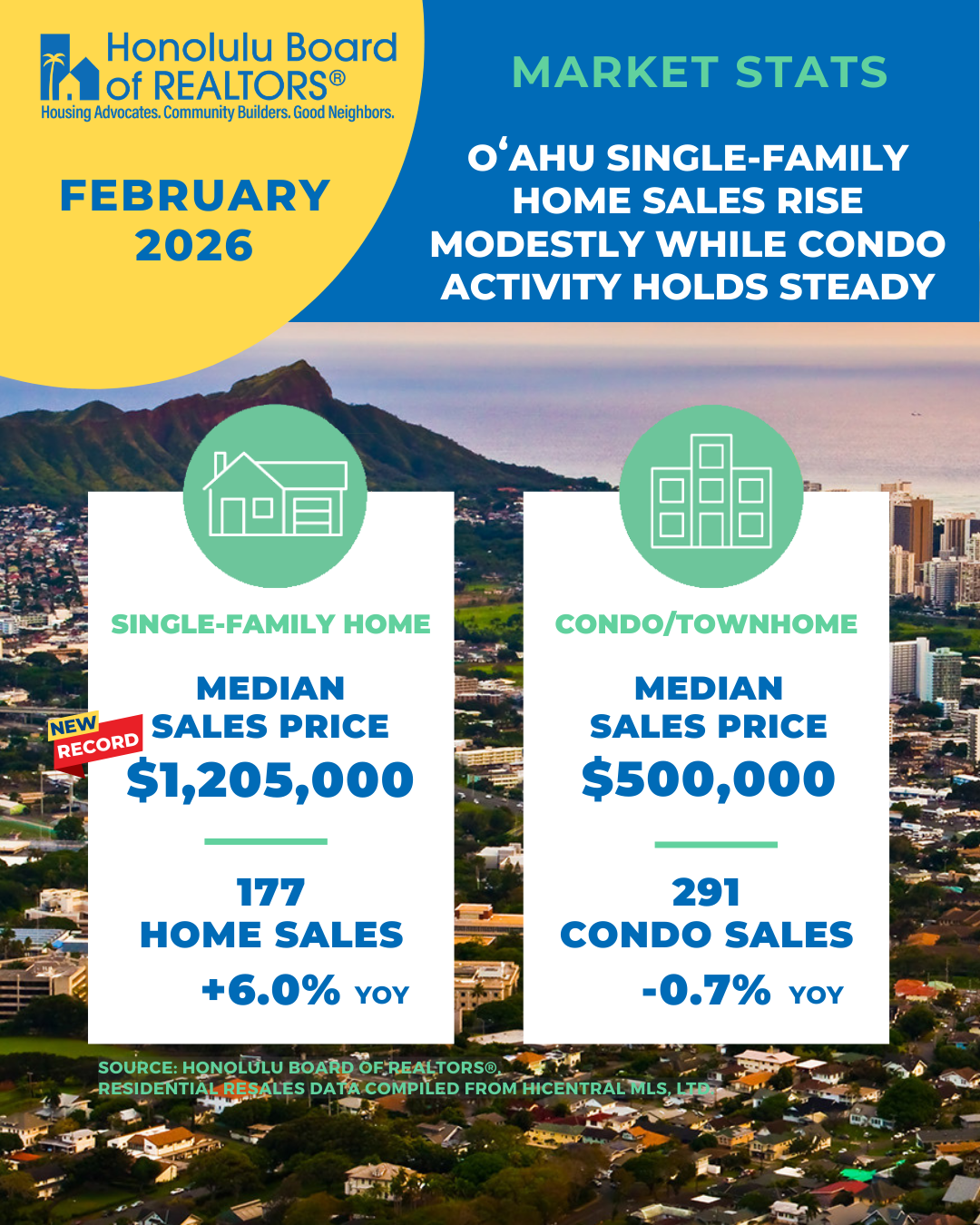
February's housing market recorded modest year-over-year increases in median sales prices, with single-family homes up 1.7% and the condominium median price increasing 1.2%. Single-family home sales rose 6% year-over-year, with 177 sales compared to 167 last February, while condo sales were relatively steady with 291 sales, a 0.7% decrease from 293 transactions a year ago.

Highlights from our February Monthly Statistics Report:

Homes priced at $500,000 and below accounted for 149 sales in February and 295 year-to-date, with 1,148 active listings available in that price range.

Days on market: Single-family homes moved faster with a median of 17 days on market compared to 23 days last February, while condominiums took longer to sell at 56 days, up from 48 days.

New listings: Seller activity remained similar to last year, with 284 new single-family home listings recorded in February, a 1.1% year-over-year increase, while new condominium listings declined 1.9% to 629.

Active inventory: At the end of February, active inventory totaled 673 single-family homes, remaining 7.6% below last year's levels, while condominium inventory increased 5.4% year-over-year to 2,276 listings.

"February's median price reflects the mix of homes that sold during the month rather than a sudden shift in market conditions," said Aaron Tangonan, president of the Honolulu Board of REALTORS®. "February typically represents one of the smaller sales samples of the year, and a greater share of sales in higher price ranges influenced the monthly median. Looking beyond a single data point is where working with a REALTOR® can help buyers and sellers better understand broader market trends."

Posted in Housing Stats
Feb. 16, 2026

What 2025’s Market Shift Means for Hawaii Real Estate

Mortgage Rates Moved Meaningfully Lower in 2025

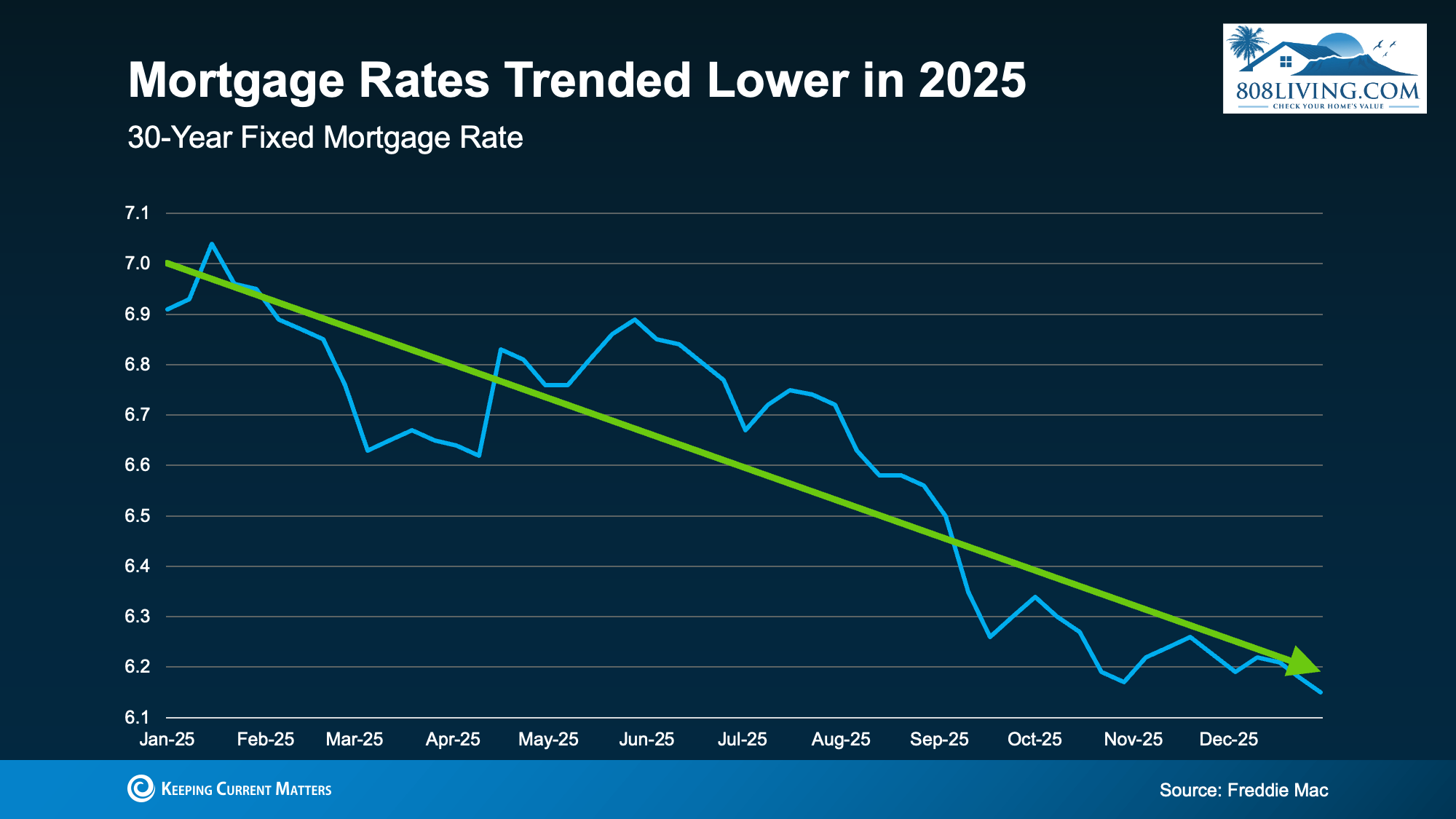
One of the biggest stories of 2025 was the decline in mortgage rates.

We started the year with the 30-year fixed hovering around 7%. Over the course of the year, rates steadily trended downward, landing in the low 6% range by year-end. Even now, we’re seeing rates bounce around 6.2%–6.25%, depending on economic data and global events.

That move, roughly three-quarters of a percent, was significant. It improved affordability, brought more buyers back into the market, and shifted overall momentum. Most forecasts suggest rates will likely remain in the low 6s this year, barring any major economic surprises.

Lower rates didn’t create a frenzy like we saw in 2020–2021, but they did meaningfully stabilize demand.

Inventory is Rebuilding and That’s a Big Deal

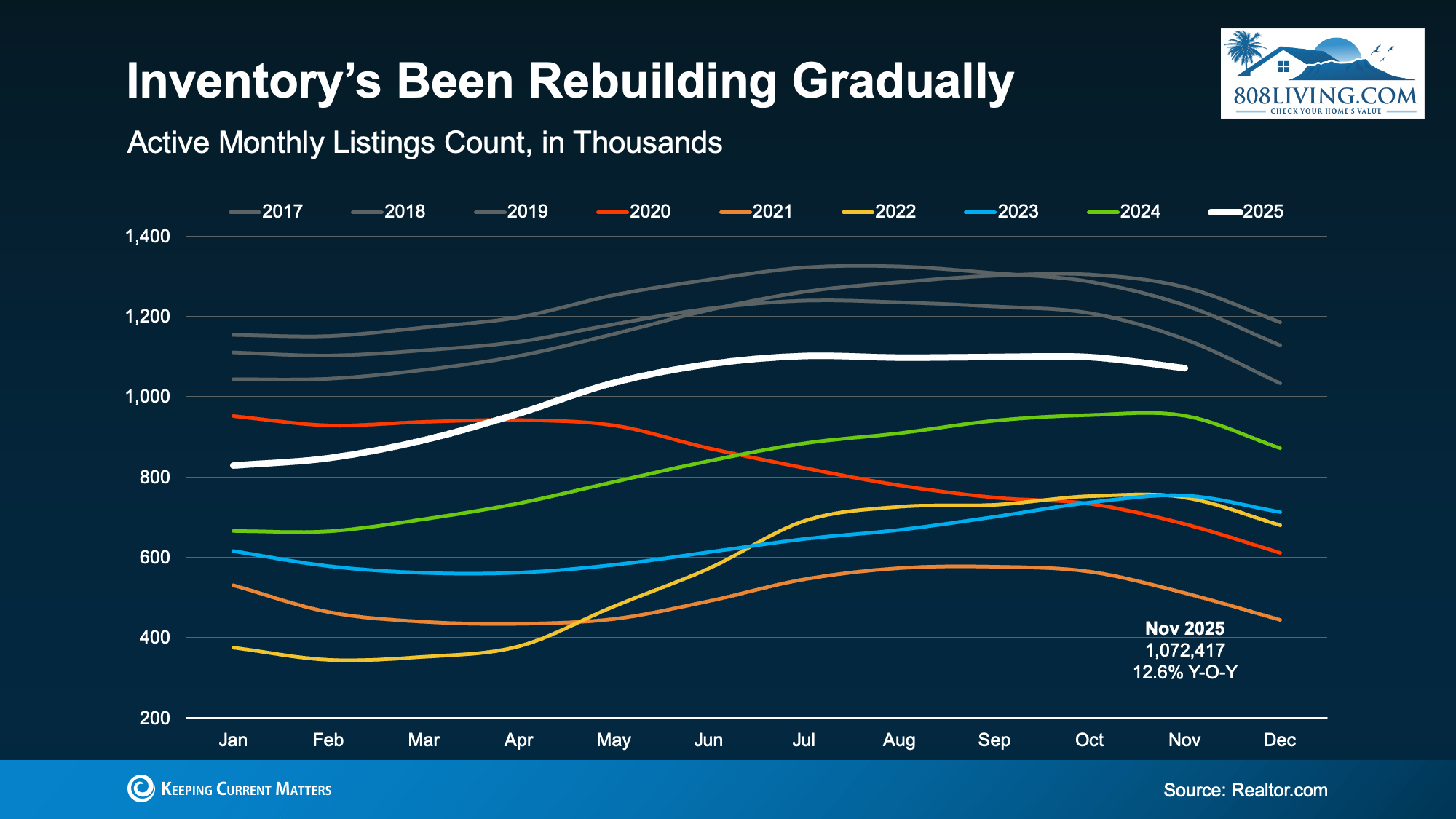
At the same time rates were coming down, inventory was climbing.

Throughout 2025, the number of active listings steadily increased. By late in the year, we were approaching levels more consistent with 2017–2019, the pre-COVID “normal” market.

That’s an important shift.

For the past few years, ultra-low inventory was the defining characteristic of the housing market. Now, supply is rebuilding:

  • Buyers have more choices

  • Sellers face more competition

  • Price growth has moderated

While we’re not fully back to pre-pandemic norms everywhere, the trend is clear: the market is rebalancing.

The Big Picture

When you step back and analyze the data, the story becomes clear.

In 2025:

  • Mortgage rates moved meaningfully lower

  • Inventory steadily rebuilt

  • Price appreciation moderated

That combination signals a market that is normalizing, not declining.

We are transitioning away from the artificial, stimulus-driven conditions of 2020–2022 and moving toward a more sustainable environment, one driven by fundamentals. Lower rates improved affordability. Increased inventory restored negotiation and choice. Slower price growth reduced volatility.

But here’s what matters most: national headlines don’t dictate local outcomes.

Real estate has always been hyper-local. Inventory levels, absorption rates, pricing pressure, and buyer behavior vary dramatically by city, neighborhood, and even price band. Interpreting those nuances, and knowing how to position a buyer or seller accordingly, is where true expertise comes in.

The data tells us the market is rebalancing.
The strategy depends on where you are and what you’re trying to accomplish.

And that leads to the real question: What’s next?

Posted in Real Estate News
Feb. 9, 2026

February '26 Housing Update

O'ahu Housing Market Begins 2026 with Stable Single-Family Home Sales, Softer Condo Activity

Homes priced at $500,000 and below account for 146 sales in January as overall market activity remains steady


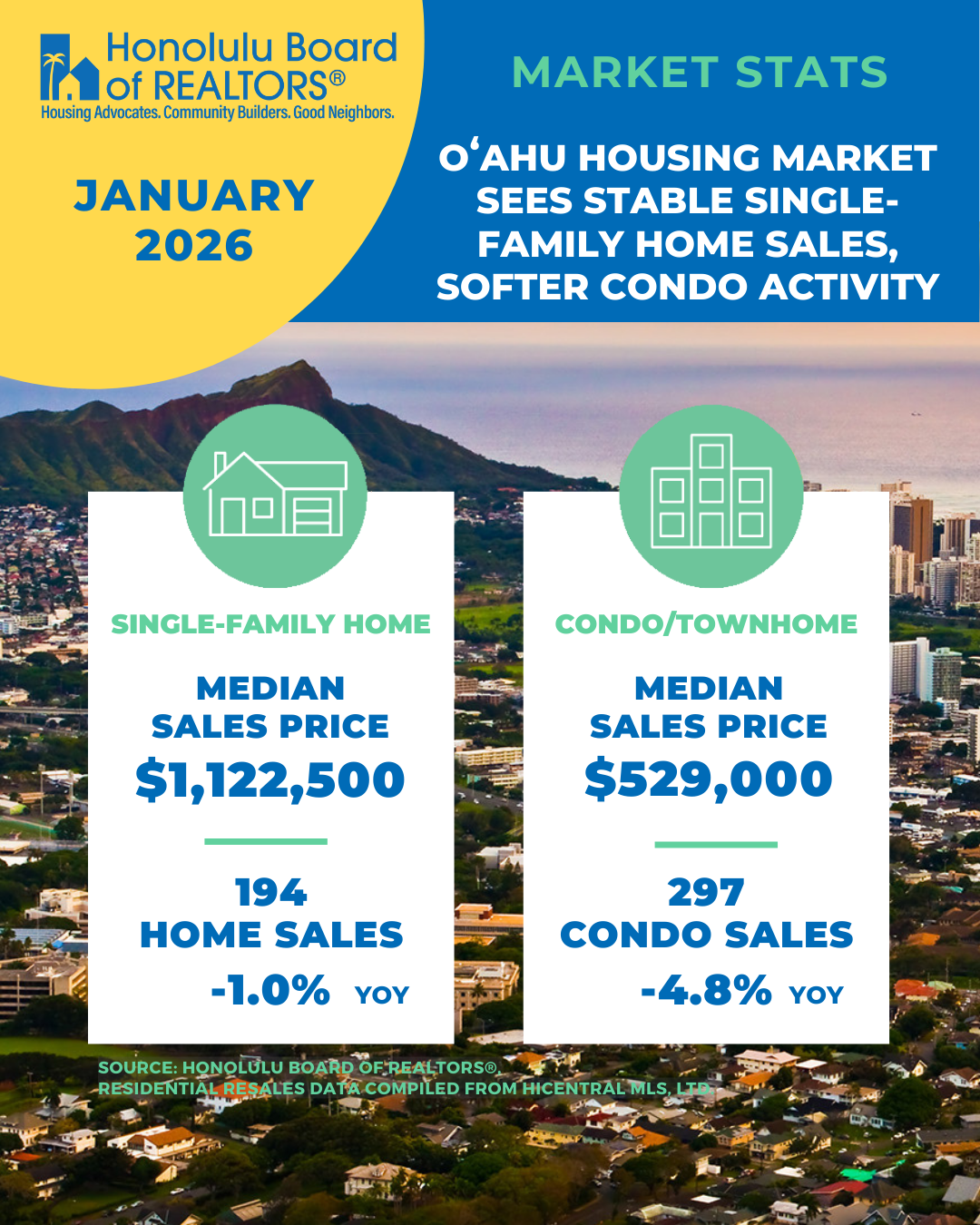
O'ahu's housing market opened 2026 with generally steady conditions compared to January 2025, with single-family home sales holding relatively stable and condominium activity softening year-over-year. Properties priced at $500,000 and below accounted for 146 year-to-date sales in January, with more than 1,000 active listings available in that price range. Overall, single-family home sales totaled 194 transactions, down 1.0% from a year ago, while condominium sales declined 4.8% year over year to 297.


Highlights from our January Monthly Statistics Report:

  • The median sales price for single-family homes modestly increased 0.2% year over year, while the condo median price dipped 1.9%.
  • Homes spent more time on the market, with single-family homes recording a median of 27 days compared to 25 days last January, and condominiums increasing from 39 to 47 days.
  • New listings for single-family homes rose 2.1% year-over-year to 343, while condominium new listings declined 5.8% to 696.
  • Active inventory for single-family homes dropped 8.2% year-over-year to 674 listings, while condominium inventory grew by 5.8% to 2,210 listings at the end of January.

"There is often a perception that sales activity is concentrated at the upper end of the market," said Aaron Tangonan, president of the Honolulu Board of REALTORS®. "January data for properties in the $500,000 and below range reflects the diversity of listings and buyer activity on O'ahu, and shows that opportunities for homeownership continue to exist, even as market conditions vary across segments."


Posted in Housing Stats
Feb. 6, 2026

Where Are Mortgage Rates Headed?

As of early January, 30-year fixed rates are around 6.2%–6.25%.

Most big forecasts (Freddie Mac, Fannie Mae, MBA, Wells Fargo) are saying the same thing: Rates should slowly trend down, not drop overnight.

There’s an old saying in real estate:

Rates go up fast (escalator)…
but come down slowly (stairs).

That’s exactly what we’re seeing.

For most of 2026, rates are expected to:

  • Hover between ~6.0% and 6.25%

  • Possibly dip into the high 5s here and there

  • Not stay in the 5s for long

What does this mean for buyers?

This isn’t a “wait forever” kind of market.

The people who benefit most are the ones who:

  • Get prepared early

  • Watch for short-term dips

  • Are ready to move when the opportunity shows up

Some buyers will catch those moments.

Thinking about buying or selling?

Every situation is different, and timing matters more than headlines.

If you want to talk strategy (even if you’re just starting to think about it), feel free to reach out anytime.

Posted in blog article
Jan. 21, 2026

January '26 Housing Update

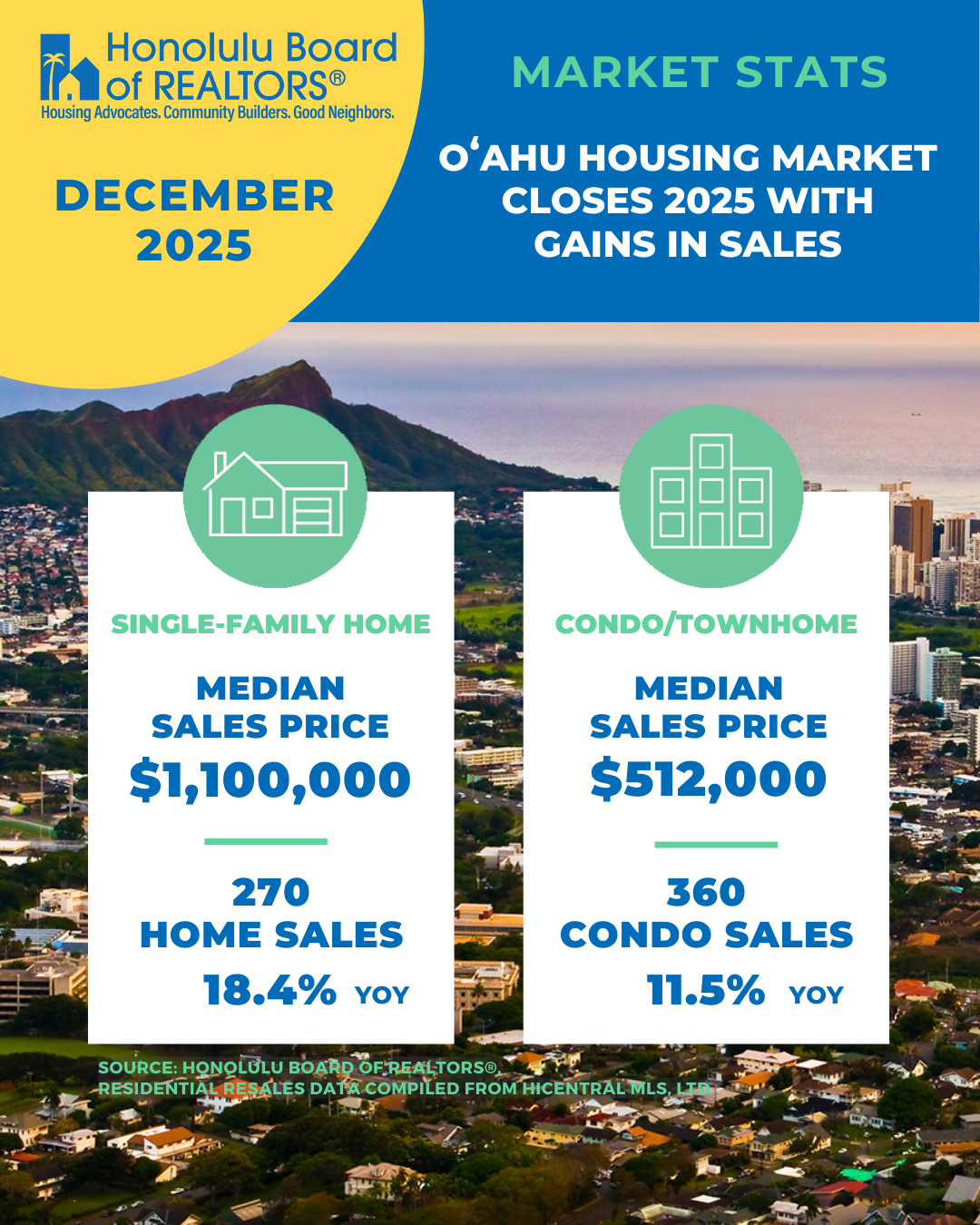
O'ahu Housing Market Closes 2025 With Gains in Sales


According to HBR's latest report, the Oʻahu housing market closed the year with gains in sales while influenced by mortgage rates, insurance costs, and broader economic conditions throughout 2025.⁠

In December, single-family home sales increased 18.4% year over year to 270 transactions, and the median sales price rose 4.3% to $1,100,000. Homes recorded a median of 22 days on market, compared to 20 days the same time last year. Active inventory was down 5.9%, ending the month with 635 active SFH listings.⁠

The condo/townhome market saw sales increased 11.5% from 323 to 360, and the median condo price fell 5.2% to $512,000. Condos spent a median of 44 days on market, 8 days longer than last December. Condo inventory rose 12.3% with 2,165 active condo listings.

Compared to 2025:

  • Combined single-family home and condo sales grew 0.6% year-over-year. Single-family home sales rose 3.5%, while condo sales declined 1.1%. In total, 2,890 single-family homes and 4,408 condos were sold in 2025.
  • The median sales price for single-family homes increased 3.5% to $1,139,000, while the annual condo median price softened 1.5% to $507,250.
  • Homes spent more time on the market, with median days on market increasing to 23 days for single-family homes and 44 days for condos.

“In 2025, O‘ahu’s housing market was shaped by a combination of economic, financial, and policy-related factors that influenced how buyers and sellers approached the market,” said Aaron Tangonan, president of the Honolulu Board of REALTORS®. “While overall activity remained steady, increased inventory, shifting costs, and broader uncertainty changed the pace and dynamics of transactions across both markets.”⁠


Posted in Housing Stats
Dec. 18, 2025

Kevin's Christmas Lights

Aloha 808Living family- Mele Kalikimaka!

We highly recommend taking the drive to Makakilo to visit this home.

The Holiday Christmas Spirit is alive and well at Kevin's Christmas Lights in Makakilo - Kapolei / Oahu. Hawaii.

Click here for Hawaii News Now feature on Kevin's Christmas Lights


Posted in Community News
Dec. 16, 2025

December '25 Housing Update

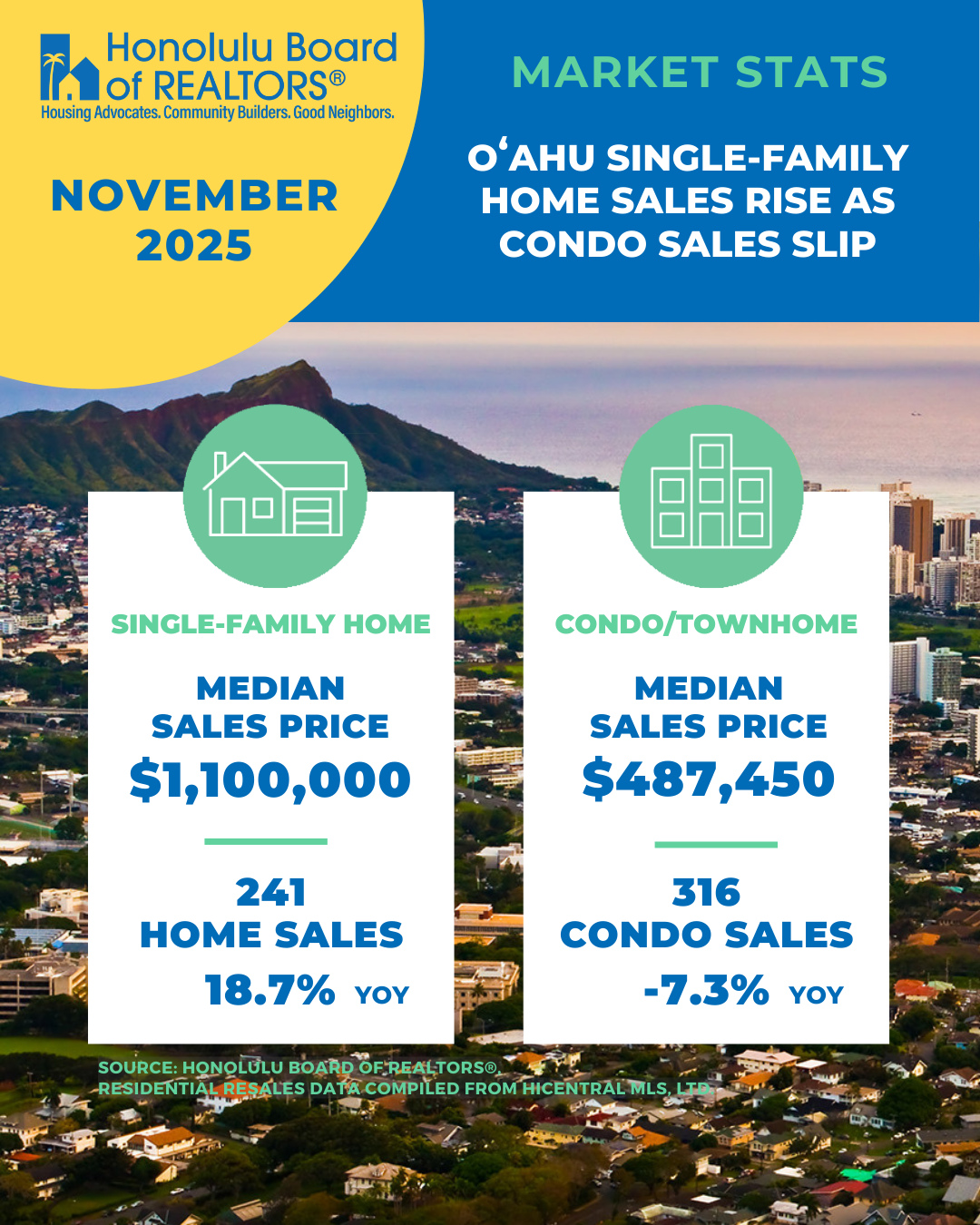
O'ahu Single-Family Home Sales Rise As Condo Sales Slip


According to HBR's latest report, the Oʻahu housing market saw a blend of growth and softening in November.⁠

Single-family home sales increased 18.7% year over year to 241 transactions, and the median sales price ticked down 1.3% to $1,100,000. Homes recorded a median of 27 days on market, compared to 24 days last November. Active inventory was down 3.3%, ending the month with 724 active SFH listings.⁠

The condo/townhome market saw sales decline 7.3% falling from 341 to 316, and the median condo price dropped 8.0% to $487,450. Condos spent a median of 40 days on market in November, 8 days longer than the same time last year. Condo inventory rose 11.5% with 2,284 active condo listings. ⁠


November 2025 Report also shows:

  • Pending sales indicated continued buyer activity, rising 12.4% from 234 to 263, in the single-family market.
  • Pending condo sales also increased, up 3.7%, from 328 to 340, with the largest increases occurring in Central Oʻahu (+47.4%) and Waipahu (+63.6%).


“November’s results reflect a market adjusting to shifts in buyer demand, pricing, and inventory,” said Trevor Benn, President of the Honolulu Board of REALTORS®. “Even with fewer new listings, buyers remained active across many neighborhoods and price points, keeping pending sales steady.”⁠


Posted in Housing Stats